If you’ve ever worked in produce distribution, floral design, or post-harvest agriculture, you’ve probably heard the term “ethylene scrubber” thrown around—usually alongside stories of how it keeps bananas from overripening too fast, or why a shipment of premium roses still looks fresh when it arrives at a boutique in another state. As someone who’s been supplying ethylene scrubbers for 12 years, I get it: most people see the name and assume it’s some fancy, black-box piece of tech only for big warehouses or commercial farms. But at its core, an ethylene scrubber is just a well-designed, efficient system that stops a tiny, odorless, almost unnoticeable gas from ruining what you care about. Today, I want to break down exactly what chemical reaction makes that happen—no overly complex jargon, just the real science that our team has tested and refined over decades of working with clients. Ethylene Scrubber

First, let’s start with why ethylene matters. Ethylene is a naturally occurring hydrocarbon gas (C₂H₄) that plants produce as part of their ripening process. It’s not unique to rotting fruit, either—apples, bananas, tomatoes, even cut flowers like carnations and lilies release it continuously. The problem is that ethylene acts like a “ripening signal” to other plants. If you have a pallet of unripe avocados next to a bunch of cut lilies, the lilies will start dropping petals within 48 hours, or the avocados will go from rock-hard to mushy in three days. Even small concentrations—like 1 part per million (ppm) in a closed trailer or storage cooler—can trigger this chain reaction. Ethylene scrubbers capture and eliminate that gas before it can cause damage, and the key to that elimination is a simple, proven chemical reaction.
Most of the industrial ethylene scrubbers we supply use a chemical called potassium permanganate (KMnO₄) as their active scrubbing agent. You might remember potassium permanganate from high school chemistry: it’s a bright purple, crystalline compound that’s been used for cleaning, disinfecting, and chemical reactions for over a century. When it comes into contact with ethylene, it doesn’t just trap the gas—it breaks its molecular structure apart through an oxidation reaction. Let’s walk through that reaction step by step, because understanding it helps explain why our scrubbers are so effective, and why not all scrubbers on the market work the same way.
Ethylene is a small molecule with a double bond between its two carbon atoms (that’s what makes it an alkene, different from methane or propane which only have single bonds). That double bond is the weak spot that potassium permanganate targets. In a water-based solution (which is how most scrubber media is formulated to work—we use a porous, lightweight substrate like activated alumina or zeolite to hold the KMnO₄, so it has lots of surface area to interact with ethylene), KMnO₄ dissociates into potassium ions (K⁺) and permanganate ions (MnO₄⁻). The permanganate ion is a strong oxidizing agent, meaning it’s hungry for electrons to stabilize itself. The double bond in ethylene has high electron density, so it gives those electrons to the permanganate ion.
This redox reaction—short for reduction-oxidation, where one substance loses electrons (oxidized) and another gains them (reduced)—is exactly what neutralizes ethylene. Here’s the balanced chemical equation, simplified for clarity: C₂H₄ + 2 KMnO₄ → 2 MnO₂ + K₂C₂O₄ + H₂O. Let’s translate that into plain English: ethylene (C₂H₄) reacts with potassium permanganate (KMnO₄) to form manganese dioxide (MnO₂), potassium oxalate (K₂C₂O₄), and water (H₂O). None of these products are harmful, and crucially, none of them are gaseous ethylene that can go on to damage produce.
I’ve watched this reaction work in our test lab a hundred times. When our new media arrives, it’s a vibrant, deep purple—you can actually see the color fading as it works, which is a handy visual way to tell when it’s time to replace the scrubber media. Once all the permanganate is reduced to manganese dioxide, the media turns a dull brown and stops reacting with ethylene. That’s why we design our scrubbers with airflow rates matched to the concentration of ethylene in your space: a cooler storing 1,000 pallets of ripe bananas needs a higher airflow and more media than a small floral cooler holding a few dozen bouquets, and our team sizes every system to the exact needs of the client.
You might be wondering: why not use other ethylene scrubbing methods, like activated carbon? Activated carbon works by adsorption, meaning it traps ethylene in its porous surface, but it doesn’t break the gas down chemically. That means over time, the carbon gets saturated and can even release the ethylene back into the air if it’s exposed to high temperatures or high humidity. Potassium permanganate scrubbing is a destructive process—once ethylene reacts with the permanganate, it’s gone for good, no risk of it leaching back into your storage space. That’s why our clients in long-haul produce shipping, who need to keep ethylene levels low for 3-7 day cross-country trips, swear by our permanganate-based systems.
But here’s what a lot of people don’t realize about these reactions: they don’t work in a vacuum. The efficiency of the scrubber depends on three factors that we prioritize when building our systems. First, moisture. The permanganate reaction needs water to occur—if the media is too dry, the KMnO₄ can’t dissociate into ions, and it can’t react with ethylene. That’s why we treat our media to maintain consistent, safe moisture levels, so it works effectively in both dry coolers and high-humidity trailer environments. Second, surface area. The media we use is porous, so it has thousands of tiny holes that ethylene can seep into, giving plenty of access to the permanganate ions. Cheaper scrubbers often use solid media with low surface area, so they run out of permanganate fast and need to be replaced every few weeks, whereas our media lasts 3-6 months in most applications. Third, airflow distribution. If air just blows straight through the scrubber without mixing with the media, the reaction won’t happen evenly. We design our scrubbers with internal baffles and airflow manifolds that ensure every cubic foot of air passes through the media, so you’re getting maximum ethylene removal with every run.
I’ve had clients come to us after buying generic scrubbers online that claimed to eliminate ethylene, only to find that their strawberries were still spoiling mid-shipment. When we tested their systems, we found two common issues: either the media was low-quality permanganate that was already mostly spent when it arrived, or the airflow was poorly designed, so only a fraction of the air was treated. That’s where our experience comes in—we don’t just sell a one-size-fits-all box; we work with you to test your space’s ethylene levels, calculate your required airflow, and provide a system that actually works with the science, not against it.
Let me give you a real example that stuck with me. A few years back, we worked with a family-owned flower farm in Oregon that shipped peonies to customers across the U.S. Peonies are incredibly sensitive to ethylene—even a single pallet of ripening apples on the same truck can make the peonies open too early, or wilt before they reach their destination. The farm had been using a small scrubber from a big box supply company that only lasted two weeks before stopping working, and they were losing up to $10,000 a month in spoiled peony shipments. We installed our custom-sized permanganate scrubber, sized to match the airflow of their refrigerated truck, and trained their driver to check the media color each trip. After that, their spoilage dropped by 92%, and they were able to expand their shipping to new markets without the risk of losing their product. That’s the difference between understanding the chemistry and just selling a product with a fancy name.
Another common question: does this reaction produce any byproducts that could be harmful to produce? I get this a lot from organic farms and specialty produce operations, who are worried about chemical residues. The reaction products—manganese dioxide, potassium oxalate, and water—are all non-toxic, and since the scrubber is designed to keep the media sealed away from the air stream that touches the produce, there’s no chance of these substances making contact with your fruits, vegetables, or flowers. We also test all our media for food safety compliance, so you can use our scrubbers in certified organic facilities without any concerns.
As with any chemical reaction, there are edge cases where permanganate scrubbers aren’t the best fit. For example, if you’re working with very high ethylene concentrations (like a ripening room where you’re intentionally applying ethylene to bananas), permanganate scrubbers aren’t the right solution—they’re designed to remove low, ambient levels of ethylene that cause unwanted ripening and spoilage. For those applications, we work with clients on custom oxidation systems that use ultraviolet light or ozone, but that’s a smaller niche. The vast majority of our clients—produce distributors, floral designers, grocery store chains, and post-harvest operations—use our permanganate scrubbers because they’re cost-effective, reliable, and based on a proven chemical reaction that’s been trusted for decades.
At the end of the day, ethylene scrubbers aren’t magic. They’re just a practical application of basic chemistry: taking a harmful, unnoticeable gas, triggering a redox reaction that breaks it down into harmless compounds, and circulating clean, ethylene-free air through your storage or transport space. What makes our systems different is that we don’t cut corners on the media, the airflow design, or the testing to make sure that reaction works as hard as it needs to for you.
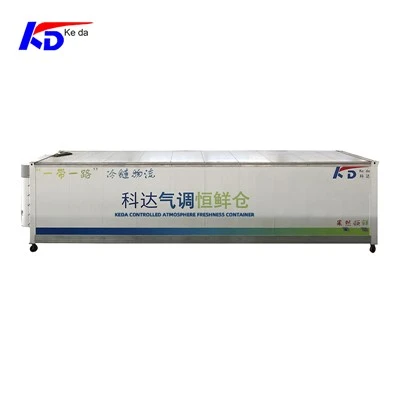
If you’re dealing with spoilage in your produce shipments, floral inventory, or post-harvest storage, and you’re tired of scrubbers that don’t deliver on their promises, let’s talk. Our team will work with you to assess your specific needs, explain exactly how our systems work, and provide a solution that fits your space, your budget, and your timeline. We’ve spent years refining our scrubber design around the science of ethylene removal, and we’re confident we can help you reduce waste, extend the shelf life of your product, and save money on spoiled inventory.
Oxygen Adsorbers References
- Saltveit, M. E. (2002). Ethylene in postharvest physiology. Horticultural Reviews, 28, 175-201.
- Kader, A. A. (Ed.). (2002). Postharvest technology of horticultural crops. University of California Division of Agriculture and Natural Resources.
- Thompson, A. K. (2003). Controlled atmosphere storage of fruits and vegetables. CABI Publishing.
- Zhang, Z., et al. (2018). Ethylene removal technologies for postharvest applications: A review. Postharvest Biology and Technology, 145, 112-122.
Yantai Keda Zhixian International Trade Co., Ltd.
As one of the leading manufacturers and suppliers of ethylene scrubber in China, we have world-leading production equipment and strong manufacturing capabilities. Please feel free to buy high-grade ethylene scrubber for sale here from our factory.
Address: No.18-2, Wuhan St, Yantai ETDZ, Yantai, Shandong, China
E-mail: ytkeda2026@163.com
WebSite: https://www.kedacastorage.com/
