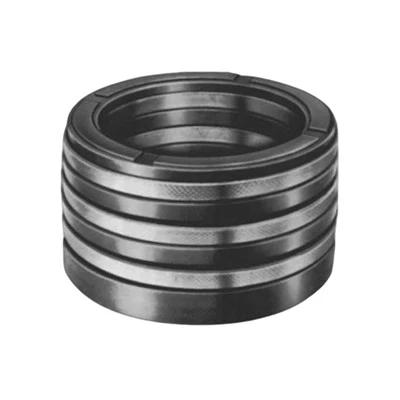
As a step seal supplier who’s spent the last 12 years sourcing, testing, and fine-tuning these components for hydraulic and pneumatic systems, I’ve lost count of how many times clients have asked, “How do I know if the step seal I’m buying is actually good enough?” It’s a fair question—step seals are tiny, non-negotiable parts that stop costly leaks, reduce energy waste, and extend equipment lifespan. Skimp on a poor-quality step seal, and you’re looking at unplanned downtime, increased maintenance, and even safety risks in industrial machinery. Step Seal
I’ve seen too many clients skip rigorous testing to cut costs, only to replace faulty seals 3 or 4 times a year instead of once. That’s why I want to walk you through the testing protocols we use in our in-house lab every day—tests that separate a high-performing step seal from one that’s just stamped and boxed. This isn’t just “lab stuff”; it’s data that translates directly to how your equipment will perform on the job site.
First, let’s get clear on what a step seal is, because misidentifying it leads to bad testing. A step seal is a two-piece dynamic seal (usually a polymer ring paired with an energizer, like a spring or O-ring) designed for reciprocating motion in hydraulic cylinders. Its “step” profile creates a narrow contact band with the cylinder wall, reducing friction and preventing extrusion under high pressure. Poorly made step seals often have uneven step dimensions, soft polymers that compress too easily, or energizers that don’t maintain consistent tension. Testing these components isn’t just checking for leaks—it’s validating they can stand up to the harsh conditions they’ll face.
Let’s start with the basics: visual inspection, but not the quick glance you’d do in a warehouse. We don’t just look for scratches (though those matter); we measure every critical dimension with a coordinate measuring machine (CMM) to confirm the step is uniform around the entire circumference. A step that’s off by even 0.02mm on one side creates a gap where fluid can sneak past. We also check the polymer surface for micro-cracks, voids, or flash (excess material from molding) that might not be visible to the naked eye. These defects often become leak points after just a few hundred cycles. I once received a batch of 50 step seals from a competitor that looked perfect at first—until our CMM showed 12 had a step height 0.05mm too low. Those 12 never sealed correctly under 1000 PSI, even in initial bench tests.
Next up: static leak testing. Dynamic performance is what most people focus on, but static sealing is non-negotiable for most applications. This test puts the seal in a test fixture, applies rated system pressure, and holds it there for 24 hours, monitoring for any fluid seepage. We test at both minimum and maximum operating pressure because a seal that works at 500 PSI might fail at 3000 PSI. For hydraulic step seals used in construction equipment, this means pushing pressures to 5000 PSI, holding for the full 24 hours, and logging every minute a leak forms. Last quarter, we turned down a small order because our lab detected a 0.1 mL/hour leak on a batch—small enough to miss in a 10-minute warehouse check, but enough to drain a 50-gallon cylinder in 200 hours of operation. That’s a difference that costs our clients thousands in lost productivity.
Dynamic cycle testing is where step seals are really put to work. This test mimics real-world motion: we mount the seal in a test cylinder, cycle the rod back and forth at a set speed (usually 0.5 to 2 m/s, matching common industrial speeds) while cycling pressure from low to maximum, and run thousands of cycles before measuring wear and leakage. We track three things here: seal friction (too much friction means higher energy costs and rod wear), volumetric leakage (any fluid that escapes past the seal), and extrusion. Extrusion is a big one—when high pressure pushes the soft polymer into the tiny gap between the seal and the gland, creating permanent damage. A high-quality step seal will have a narrow, controlled extrusion gap and a polymer that’s rigid enough to resist deformation, yet flexible enough to adapt to small surface imperfections. Our current industry-standard test for step seals runs 100,000 cycles at 3000 PSI; any seal that shows more than 0.1mm of extrusion or a leakage increase over 0.5 mL/hour after that gets rejected. We had a client switch to our seals after their previous supplier’s seals would extrude completely and fail at 45,000 cycles—our samples hit 120,000 with zero extrusion.
Temperature resistance testing is another make-or-break test. Hydraulic and pneumatic systems run in everything from arctic (-40°C) desert (70°C) conditions, so a seal that works in a 20°C lab is useless if it cracks in winter or softens in summer. We test step seals in environmental chambers, cycling temperature through their full range while running dynamic cycle tests. For general industrial seals, that’s -40°C to 120°C; for aerospace or heavy construction, we extend it to -55°C to 150°C. We check for two things: polymer brittleness (cracking at low temperatures) and thermal compression set (permanent deformation at high temperatures). A seal with bad compression set will flatten under heat, losing its preload and sealing ability. Last winter, a logging equipment operator called us saying their seals were cracking in -30°F weather; our lab tested the competitor’s seals and found they were made from a nitrile compound rated for only -20°C. We sent them our fluoroelastomer step seals, rated for -40°C, and they haven’t had a leak since.
Pressure impulse testing is a more extreme test for seals that handle sudden pressure spikes—like in mining equipment or mobile hydraulic lifts. These spikes can jump 2-3 times the normal operating pressure, and a seal that holds steady at continuous pressure might blow out during a spike. We apply pressure pulses every 10 seconds, 10,000 times, and check for damage or leaks. For a 3000 PSI step seal, that means pulsing to 9000 PSI repeatedly. Seals that are thin or have weak energizers often fail here, as the sudden pressure forces the seal away from the cylinder wall. We’ve had clients who work in high-impulse environments specifically request this test: they’d rather we flag a seal for impulse resistance than find out it fails after a week on a mine site.
Finally, we test material compatibility. Step seals aren’t just exposed to hydraulic fluid—they can contact different metals (steel, cast iron), coatings, and even other seal materials in the gland. A polymer that’s fine with mineral oil might degrade when exposed to synthetic hydraulic fluids or certain chemicals. We soak the seals in the actual fluid the client uses for 72 hours, then measure changes in hardness, weight, and dimensions. A 10% change in hardness might seem minor, but it can make the seal too soft to resist extrusion or too hard to flex with rod movement. One food processing client needed seals compatible with vegetable-based hydraulic fluid; our lab tested standard nitrile seals and found they swelled 15% in that fluid—we switched them to a special hydrogenated nitrile compound, and they no longer had seal swelling issues.
Now, this doesn’t mean you have to run all these tests yourself. Most shops don’t have the equipment or expertise for that. The key is to partner with a supplier who does, and to ask for their test data before you order. Ask for: dimensional inspection reports, static leak rates, dynamic cycle performance at your operating pressure, temperature test results, and material compatibility for your fluid. If a supplier can’t provide that, they’re probably cutting corners on manufacturing.

As a step seal supplier, we don’t just box and ship parts—we back every seal with our in-house lab testing. We’ve invested in CMMs, environmental chambers, and test cylinders specifically for step seals because we know that bad seals aren’t just a product defect; they create headaches for our clients. If you’re tired of frequent seal failures, unexpected downtime, or seals that don’t live up to their specs, let’s connect. We can walk through your application, share our test data, and work with you to source step seals that meet your performance needs without the extra costs of replacement.
Shock Absorber Seal References
- Hydraulic Seals: Design, Application, and Testing (3rd Edition), National Fluid Power Association, 2020
- Polymer Seal Compatibility Testing for Industrial Hydraulic Systems, Journal of Tribology, Vol. 142, No. 5, 2018
- Step Seal Extrusion Resistance Under High Pressure: A Comparative Analysis, International Journal of Fluid Power, Vol. 21, No. 3, 2020
- Dynamic Cycle Testing for Reciprocating Seals, American Society of Mechanical Engineers (ASME) Standard B93.1-2019
Hebei Jinwo Machinery Technology Co., Ltd.
Hebei Jinwo Machinery Technology Co., Ltd. is one of the most professional step seal manufacturers and suppliers in China, featured by quality products and good price. Welcome to buy bulk advanced step seal in stock here and get pricelist from our factory. We also accept customized orders.
Address: Room 2109, Tower A, Meidong International, No.16 Guang’an Avenue, Chang’an District, Shijiazhuang City, Hebei Province, China
E-mail: info@jinwoseal.com
WebSite: https://www.jinwoseal.com/
